

Warehouse Mezzanines: Benefits, Costs, and What to Know Before You Buy
Considering a mezzanine to add storage space? Here's what warehouse mezzanines cost, their real benefits, and what to check before you install one.
Admin
7/16/20263 min read
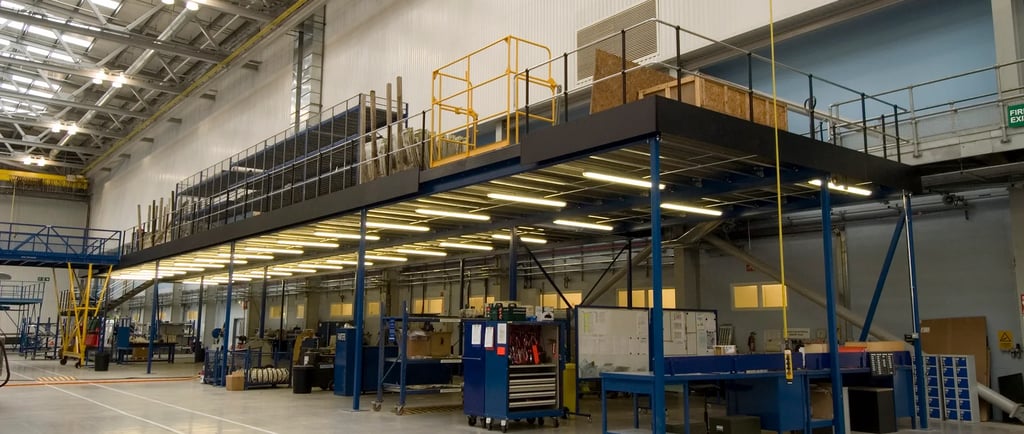
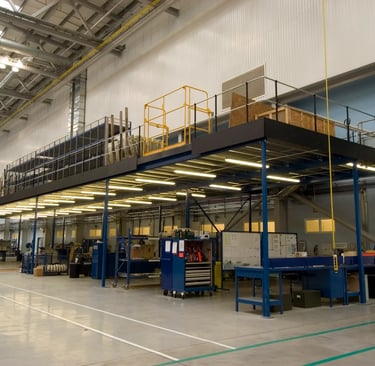
When a warehouse runs out of floor space, the instinct is often to look for a bigger building. But relocating or expanding a facility is expensive, disruptive, and often unnecessary — a lot of warehouses simply aren't using the vertical space they already have. A mezzanine solves that by adding a second level of usable floor space within your existing building footprint.
Here's what to know before deciding if one makes sense for your operation.
What a Mezzanine Actually Is
A mezzanine is a raised, semi-permanent platform installed inside your existing warehouse, effectively adding a second floor above a portion of your building without any construction to the structure itself. Depending on your layout and needs, mezzanines typically come in a few forms:
Free-standing mezzanines, supported by their own columns, independent of racking or shelving below
Rack-supported mezzanines, built using the racking beneath as part of the structural support
Shelving-supported mezzanines, similar in concept but integrated with shelving units
The right type depends on what's happening underneath — whether that space is used for racking, shelving, or simply open floor storage.
Why Businesses Add a Mezzanine
More storage without moving. This is the most common driver — a mezzanine can effectively double the usable storage area in a given footprint, without the cost, downtime, and disruption of relocating to a larger facility.
Lower cost than expansion. Building an addition or moving to a bigger space typically runs well above what a mezzanine installation costs for a comparable amount of added floor space. For most warehouses, a mezzanine delivers a meaningfully faster return on investment than new construction.
Flexible use of space. Beyond pure storage, mezzanines are commonly used for packing and shipping stations, equipment platforms, or office space overlooking the warehouse floor — letting you separate functions without losing floor-level operational space.
Minimal downtime. Most mezzanine installations, especially modular systems, can be completed in a matter of days rather than the months a construction project would take.
What Affects the Cost
Mezzanine pricing varies significantly based on a few key factors:
Size. Larger mezzanines typically cost less per square foot than smaller ones, since fixed costs (engineering, access points) are spread across more usable space.
Load capacity. A mezzanine built to hold light storage costs less than one engineered for heavy palletized goods or equipment.
Decking material. Options range from steel grating to plywood to solid steel decking, each with different costs and use cases.
Additional features. Staircases, safety railings, gates, lighting, and conveyor cutouts all add to the total project cost.
New vs. used. A used or reconditioned mezzanine system can bring the cost down substantially compared to a fully custom new build, particularly for standard rectangular layouts.
Questions to Ask Before You Install One
How much clear height do you actually have? Mezzanines need enough vertical clearance both above and below the platform to be useful — this is one of the first things worth measuring before assuming a mezzanine will work for your space.
Will the space be occupied by employees? If people will be working on or under the mezzanine, fall protection, guard railing, and access requirements come into play, and your provincial workplace safety regulations will dictate what's required.
Do you need a permit? Mezzanine installations frequently require a building permit and code approval, particularly when the space will be occupied rather than used purely for storage. This is worth confirming with your municipality before committing to a design.
What's actually going on the mezzanine? Storage, office space, and equipment platforms all have different load and layout requirements — deciding this upfront avoids costly redesigns later.
New vs. Used Mezzanines
Because mezzanines are modular, engineered structures, a used system in good condition can be reconfigured to fit a new space, often at a significant discount compared to new construction. The trade-off is availability — used systems come in whatever dimensions and condition they were originally built for, so some adaptation is usually needed. For standard storage applications without highly specific dimensional requirements, used is frequently the more cost-effective route.
Is a Mezzanine Right for Your Warehouse?
If you're running out of floor space but aren't ready for the cost and disruption of relocating, a mezzanine is one of the highest-return investments available for a warehouse — provided your clear height, budget, and intended use line up with what's realistic for your building.
We supply and install both new and used mezzanines throughout Montreal, St. Laurent, West Island, and Dorval, and can walk you through what's realistic for your space before you commit to a design. Browse our mezzanine options or contact us for an assessment of your warehouse.